


The Jontay Porter Case: How Player-Prop Manipulation Led to a Lifetime NBA Ban
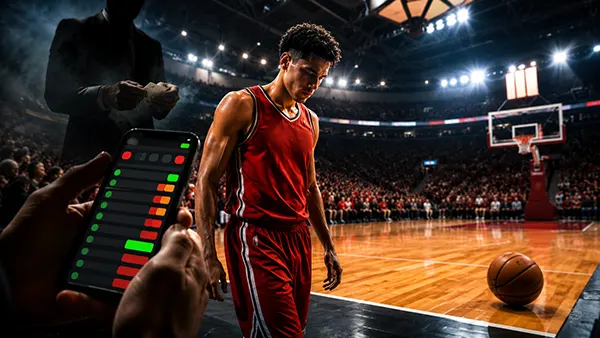
Jontay Porter’s removal from the NBA was not the result of one careless wager or a vague breach of betting etiquette. The league concluded that the Toronto Raptors forward-centre shared confidential health information with bettors, deliberately limited his participation in at least one game to affect wagers on his statistics, and placed NBA bets through another person’s account. Those findings led Commissioner Adam Silver to impose a lifetime ban on 17 April 2024. Federal prosecutors later built a criminal case around two Raptors games in which associates knew Porter would leave early and backed “under” bets on his points, rebounds, assists and other figures. By 2026, the case had become a defining warning about how individual player markets can be manipulated and why sporting integrity depends on more than the final score.
From a Fragile NBA Career to a Betting Investigation
Porter’s route to the NBA had already been difficult. He was regarded as a talented prospect at the University of Missouri, but serious knee injuries disrupted his development and contributed to him going undrafted in 2019. He later earned opportunities with the Memphis Grizzlies, several NBA G League teams and, eventually, the Toronto Raptors. During the 2023–24 season, Toronto signed him to a two-way contract, an arrangement that allowed him to move between the Raptors and their G League affiliate, Raptors 905. He was not a leading scorer or a guaranteed starter. His value came from size, passing, rebounding and the ability to fill short-term gaps in an injury-hit squad.
That uncertain role matters when considering the betting markets surrounding him. Sportsbooks were offering wagers on relatively small statistical targets because Porter usually played limited minutes. A line might ask whether he would finish above or below a modest total for points, rebounds or assists. For a regular rotation star, one short spell on the bench may not decide such a wager. For a reserve whose entire appearance might last ten or fifteen minutes, an early departure can settle several “under” bets almost immediately. This did not make Porter responsible merely because his role was small, but it made private information about his expected playing time unusually valuable.
Concern grew after unusual betting activity was linked to two Raptors games, one on 26 January 2024 and another on 20 March 2024. In both contests, bettors placed money on Porter finishing below listed statistical totals, and in both he left after only a few minutes. A single early exit can occur for perfectly legitimate medical reasons, especially in a demanding sport. The combination of advance knowledge, concentrated wagers and repeated outcomes was different. Licensed betting operators and an integrity-monitoring organisation alerted the NBA after the March game, giving the league data that could be compared with Porter’s communications, account activity and conduct.
The Two Games That Triggered Alarm
On 26 January 2024, Toronto played the Los Angeles Clippers. Porter entered during the first quarter and remained on court for about four minutes. He recorded no points, three rebounds and one assist before telling team staff that an eye problem had worsened. Federal prosecutors later said associates had been informed before the game that he intended to remove himself early. Because his final totals stayed below several sportsbook lines, wagers on his underperformance succeeded. Court filings described one $10,000 parlay that returned $85,000 and another $7,000 parlay that returned $40,250, illustrating how a very short appearance could produce substantial gains for people holding advance information.
The 20 March game against the Sacramento Kings drew even greater attention. The NBA found that Porter had disclosed confidential information about his health to a person he knew was an NBA bettor. An associate then placed an $80,000 parlay predicting that Porter would fall short of several statistical targets, with a potential payout of $1.1 million. Porter played three minutes, recorded no points, three rebounds and no assists, and left after saying that he felt ill. The wager would have won, but the sportsbook froze it because the activity was considered suspicious, so the proposed payout was not made.
Betting surveillance was central to exposing the pattern. Legal sportsbooks record the time, size and structure of wagers, while specialist monitors compare activity across the market. A sudden concentration of large bets on an unheralded reserve to underperform can stand out, particularly when several selections are combined in a parlay. The same regulated records that allowed the wagers to be placed also created an evidence trail. This is one reason the Porter case cannot be reduced to speculation based on two poor box scores: the investigation combined game footage, medical and participation information, betting data, account records and communications involving people connected to the scheme.
What the NBA Found and Why the Punishment Was Permanent
The NBA announced three separate categories of misconduct. First, Porter disclosed confidential information to sports bettors. Second, he limited his own participation for betting purposes. Third, he personally wagered on NBA games through an associate’s online account. Each violation would have raised serious disciplinary questions on its own. Together, they struck at the league’s basic promise that players compete honestly and that people with inside access do not use it to secure a financial advantage. The lifetime ban therefore addressed a pattern of behaviour rather than a single technical breach.
Sharing private health or availability information is especially damaging because betting prices are built on what the public knows. A player and his close contacts understand physical condition, planned minutes and possible withdrawal before most supporters or bookmakers do. When that information is passed to selected bettors, the market is no longer fair. The issue becomes more severe when the player can help produce the predicted result by leaving early. In Porter’s case, the NBA said he limited participation to influence one or more bets. Federal prosecutors later described agreements to exit the January and March games so that associates could profit from under wagers.
The league also found that Porter placed at least 13 NBA bets from January to March 2024 while travelling with the Raptors or Raptors 905. He used another person’s account, and the stakes totalled $54,094. The wagers produced total payouts of $76,059, leaving net winnings of $21,965. None concerned a game in which Porter appeared, but three multi-game parlays included a bet that Toronto would lose; all three of those parlays failed. This distinction is important for accuracy: the bets on Porter’s own statistics were placed by associates, while his personal betting involved other NBA games. Both forms of conduct violated league rules and created an obvious conflict with his duties as a player.
Why Player-Prop Betting Created a Direct Conflict
A player proposition bet focuses on an individual event or statistic rather than simply asking which team will win. Common examples cover points, rebounds, assists, three-pointers or combinations of several categories. Bettors choose whether the player will finish over or under a number set by the sportsbook. These markets can make an otherwise ordinary part of a match financially significant. A missed rebound, a substitution or a medical withdrawal may determine thousands of wagers even when it has little effect on the final result.
That creates a form of risk often called spot-fixing: manipulating a limited element of a contest without necessarily arranging the overall winner. In basketball, an athlete does not have to miss every shot or deliberately lose the match to affect an under bet. Leaving early can be enough. The danger is particularly clear for players on short-term or two-way contracts, whose projected totals and playing time are low. A bettor with reliable notice of an early exit can remove much of the uncertainty that is supposed to make a wager legitimate.
The Porter case should not encourage people to treat every injury, substitution or low-scoring performance as evidence of corruption. Professional players regularly leave games for genuine medical reasons, and reserve minutes change according to tactics, foul trouble and the score. The decisive factor here was the wider evidence: advance communication, organised betting, unusual stake patterns, account records and the NBA’s finding that participation had been restricted for betting purposes. Responsible analysis separates an unexpected performance from a proven integrity breach and avoids turning ordinary sporting variance into accusation.

The Criminal Case, Wider Fallout and Lasting Lessons
The league’s disciplinary process was followed by a federal criminal case in New York. Prosecutors alleged that Porter had accumulated gambling debts and agreed to leave selected games early so associates could win bets and share the proceeds. On 10 July 2024, he pleaded guilty to conspiracy to commit wire fraud. In court, he acknowledged that he had agreed to withdraw early from games to help clear large gambling debts. A guilty plea carries consequences beyond a sporting sanction because it recognises that the scheme was designed to deceive betting businesses and obtain money through false representations.
Other participants were arrested, charged or entered guilty pleas as investigators traced communications, payments and betting activity. The Porter matter later appeared within a wider federal examination of insider information and manipulated player markets in professional basketball. That broader context does not alter the evidence required in each individual case, but it shows why the NBA regarded Porter’s conduct as more than a private gambling problem. Once confidential team information and intentional game actions are traded for betting profit, the harm extends to teammates, opponents, sportsbooks and supporters who expect authentic competition.
As of 2026, the NBA ban remained permanent. It did not amount to a worldwide prohibition on playing basketball, and Porter returned to professional competition with the Seattle SuperHawks in the relaunched United States Basketball League in March 2026. Early-2026 reports still described him as awaiting federal sentencing. His return outside the NBA therefore did not reverse the league’s decision or erase the criminal case. The distinction is useful: the NBA controls eligibility within its own competition and associated operations, while federal courts determine punishment for the admitted fraud conspiracy.
What Changed After the Porter Scandal
The immediate response went beyond punishing one player. Major sportsbooks stopped offering certain under bets on NBA players holding two-way or ten-day contracts, reducing markets considered vulnerable to advance knowledge or deliberate early withdrawal. The NBA and the players’ union also supported tighter limits on some proposition wagers. Such restrictions cannot remove every integrity threat, but they narrow the range of bets that can be settled by one easily controlled event and make it harder to place large sums on players with uncertain roles.
The case also demonstrated the value and the limits of regulated betting. Legal operators were able to flag the $80,000 parlay, freeze the potential $1.1 million payout and share information with investigators. That transparency helped reveal suspicious activity. At the same time, the availability of detailed player markets created the opportunity that was exploited. Effective protection therefore requires several safeguards working together: clear league rules, education and support for players, account checks, limits on vulnerable wagers, prompt reporting and independent review of unusual betting patterns.
Porter’s case remains significant because it shows how quickly a promising career can be lost when private information, personal debt and control over playing time intersect. The lifetime ban was not imposed simply because betting existed around an NBA game. It followed findings that a player crossed the line from being the subject of a wager to helping selected bettors gain an unfair advantage, while also wagering on the league himself. For athletes, teams and regulators, the central lesson is straightforward: confidence in professional sport depends on every participant being seen to compete without a hidden financial interest in what happens next.