


Milano Cortina 2026: How the First Distributed Winter Olympics Changed the Games Model

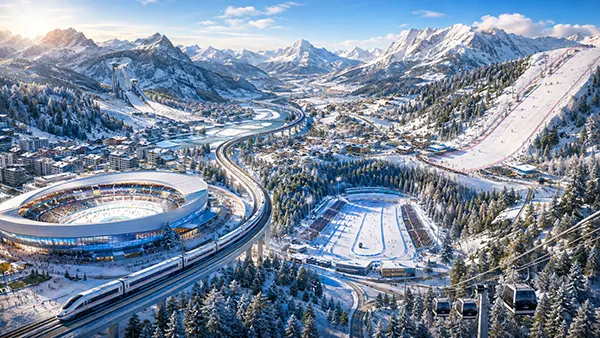
Milano Cortina 2026 represented a significant change in the geography of the Winter Olympics. Instead of concentrating most competitions, accommodation and ceremonies around one host city, the Games were organised across a broad area of northern Italy, combining Milan with established Alpine destinations such as Cortina d’Ampezzo, Bormio, Livigno, Anterselva and Val di Fiemme. The Olympic Winter Games ran from 6 to 22 February 2026, but their importance extended beyond the competition schedule. Milano Cortina became the first Winter Olympics built around a fully multi-centred model, with different areas performing distinct roles rather than operating as satellites of one dominant Olympic city. Competitions and ceremonies were spread across more than 22,000 square kilometres, making the edition the most geographically dispersed Winter Games in Olympic history. This arrangement demonstrated that a future Olympic host does not necessarily need to reproduce every required sports facility within one metropolitan area. It can instead connect cities and regions that already possess suitable venues, expertise and accommodation.
From One Olympic City to a Network of Host Regions
For much of Olympic history, the name of a single city defined an edition of the Games. Even Winter Olympics that used mountain resorts outside the main urban centre normally retained a clear geographical core. Milano Cortina 2026 went considerably further. Milan provided the major urban element, including ice sports, the main media facilities and the Olympic opening ceremony at San Siro. Cortina d’Ampezzo hosted women’s Alpine skiing, curling and the sliding disciplines, while Anterselva provided an established home for biathlon. Bormio hosted men’s Alpine skiing and ski mountaineering, Livigno staged freestyle skiing and snowboard competitions, and Val di Fiemme was used for Nordic disciplines. Verona, which was not a competition cluster in the traditional sense, became another part of the Olympic map by hosting the closing ceremony at the historic Arena di Verona. Rather than forcing unrelated sports into one area, the programme followed northern Italy’s existing sporting geography.
This distinction matters because the Olympic name itself reflected a partnership rather than a conventional host-city arrangement. Milan and Cortina d’Ampezzo are separated by hundreds of kilometres, and several other competition areas lie in different provinces and administrative regions. The wider Games involved Lombardy, Veneto, Trentino and South Tyrol, connecting a major European city with mountain communities whose sporting identities had developed independently over decades. Cortina had already hosted the 1956 Winter Olympics, Anterselva was an established international biathlon venue, Bormio had a long history of elite Alpine skiing, and Val di Fiemme regularly staged major Nordic competitions. Milano Cortina therefore did not begin by asking where new Olympic facilities could be placed. In many cases, organisers began with places where the relevant sports were already embedded in local life and then built the Olympic map around those assets.
The official venue list illustrates the scale of this approach. Olympics.com identifies 15 venues connected with the Olympic programme, ranging from Milan’s ice facilities to the Stelvio Ski Centre in Bormio, the Livigno snow venues, the Anterselva Biathlon Arena, Tesero Cross-Country Skiing Stadium and Predazzo Ski Jumping Stadium. The arrangement meant that spectators could not treat the entire Olympics as one compact destination. A visitor based in Milan could reasonably combine several ice events, but travelling from Milan to a mountain competition was a different type of journey. Similarly, someone staying in Cortina was close to Alpine skiing and sliding events but far from Milan’s hockey and skating programme. The Games consequently became a collection of connected local Olympic experiences rather than one continuous urban festival. That was one of the clearest changes produced by the distributed model.
Why Existing Sporting Geography Became the Starting Point
The main advantage of distributing the Games was the opportunity to match sports with places that already had suitable facilities and experience. Building a specialised venue purely because every event must sit close to one host city can create a difficult legacy once the Olympics have ended. A ski jump, biathlon stadium or large Alpine course has limited value if the surrounding area does not have a strong long-term connection with that sport. Northern Italy offered a different possibility. The masterplan prioritised established venues that could be upgraded where necessary, supplemented by temporary facilities and a smaller number of new projects. Official environmental planning documents state that most venues already existed, although many required modernisation, expansion or temporary Olympic installations. This was not a construction-free Olympics, but the starting assumption had changed from building a self-contained Olympic territory to making greater use of an existing sporting network.
There were important exceptions. The Milano Santagiulia Ice Hockey Arena was developed as a new venue, while the Cortina Sliding Centre was built on the site associated with the former Eugenio Monti track. Milan also received a new Olympic and Paralympic Village. At the same time, speed skating and additional ice hockey capacity at the Rho exhibition area relied on temporary arrangements. This mixture is important when assessing Milano Cortina 2026. The distributed model did not eliminate new construction; instead, it made it possible to be more selective about where permanent investment was considered necessary. A venue could be new because it had a planned post-Games purpose, while another Olympic requirement could be met temporarily rather than leaving behind a specialised building with uncertain demand. The model was therefore based more on adapting the Games to local conditions than on applying the same construction formula to every sport.
A similar principle applied to athlete accommodation. There was no requirement for every competitor to live in one enormous central Olympic Village and travel long distances to competition sites. Existing hotels were incorporated into the village system in Bormio, Livigno and Anterselva, while Predazzo used an existing facility connected with the Guardia di Finanza. Cortina used a temporary village concept, whereas Milan’s newly built village was designed with a post-Olympic purpose that included conversion into student accommodation. Keeping athletes closer to their competition areas reduced the need for daily cross-regional journeys and allowed each cluster to function more independently. In practical terms, the Games were decentralised not only on a map but also in accommodation, transport planning, training arrangements and services for teams.
What the Distributed Model Changed for Athletes, Fans and Organisers
For athletes, decentralisation could make daily competition routines more logical. A skier competing in Bormio did not need to stay in Milan simply because Milan was one of the official host cities. Athletes could live and prepare within the area assigned to their sport, shortening the most important journey of all: the regular trip between accommodation, training and competition. This approach was particularly suitable for winter sport because mountain disciplines already depend heavily on specific terrain, altitude, snow conditions and established courses. Moving an athlete once to the appropriate cluster was more practical than repeatedly moving that athlete across northern Italy. At the same time, decentralisation changed the traditional social character of an Olympic Village. Instead of nearly every delegation sharing one main residential centre, athletes experienced the Games through several communities. That made the Olympic environment more localised and placed greater importance on ensuring comparable services and atmosphere in each area.
For spectators, the consequences were more noticeable. Milano Cortina rewarded visitors who planned around a particular sport or geographical area rather than those attempting to attend unrelated events across the whole schedule. Ice hockey, figure skating and speed skating could be combined relatively easily within the Milan area. A skiing-focused visit could instead be organised around one of the Alpine clusters. Moving between distant clusters was possible, but it required more time and planning than at a compact event. During the Games, the Associated Press described a journey of more than four hours by road between Bormio and Tesero, an example of how significant the distances could become when someone needed to attend events in separate mountain areas. The distributed Games therefore encouraged a different spectator mentality: attending the Olympics did not necessarily mean seeing the whole Olympic territory. For many visitors, it meant experiencing one distinctive part of it.
For organisers, meanwhile, the challenge shifted from concentrating enormous demand in one city to coordinating many smaller operational centres. Transport services, volunteers, security, medical support, competition management, accommodation and communications all had to work across several areas with different physical conditions. Milan offered dense public transport and large-scale urban infrastructure, while Alpine locations had narrower valleys, mountain roads and more limited local capacity. The model therefore reduced some forms of concentration while increasing the importance of coordination. Organisers also had to prevent the individual clusters from feeling like separate competitions with only a distant connection to the Olympics. Milano Cortina 2026 chief executive Andrea Varnier said during the Games that creating an Olympic atmosphere in every location was a central challenge of the widespread arrangement. That issue was cultural as well as logistical: decentralisation had to preserve a shared identity.
The Trade-off: Less Centralisation but More Complex Movement
The widest geographical footprint in Winter Olympic history inevitably made transport one of the model’s main tests. Covering more than 22,000 square kilometres means that a timetable can look close on paper while involving substantial real-world travel through mountain areas. Roads may be affected by winter weather, valleys can have limited alternative routes, and large numbers of spectators create temporary pressure on communities that are much smaller than Milan. This does not mean every athlete or visitor was constantly travelling across the entire Games area. In fact, the cluster system was designed specifically to avoid that. The difficulty arose when people needed to move between clusters: officials following several sports, media teams, national representatives, spectators with varied tickets or staff with responsibilities in different locations. A distributed Olympics therefore depends less on one giant urban transport system and more on reliable connections between several transport networks.
The opening ceremony showed how organisers tried to address another effect of the distance. San Siro in Milan remained the main ceremonial venue on 6 February, but Milano Cortina designed the event as a multi-centred experience involving athletes in Milan, Cortina, Valtellina and Val di Fiemme. This was more than an artistic choice. Under a conventional arrangement, athletes can travel from one central village to one stadium. Under Milano Cortina’s geography, bringing every competitor to Milan shortly before competition would have been impractical for many teams. The ceremony therefore adapted to the geography rather than forcing the geography to adapt to the ceremony. The closing ceremony then shifted the focus again, taking place at the ancient Arena di Verona on 22 February. Major symbolic events were thus distributed as well as sporting events, reinforcing the idea that no single city represented the whole edition.
Media operations also illustrate the changing logic. A traditional Olympic press corps can work from a central media centre and reach many venues within one urban area, whereas Milano Cortina required coverage teams to decide where people genuinely needed to be based. Modern remote production and digital workflows made that easier than it would have been in earlier decades. Olympic Broadcast Services prepared a more compact on-site production structure for 2026, with greater use of cloud and virtualised production methods intended to reduce the amount of equipment and personnel that had to be present everywhere. The technology itself was not the reason for the distributed Games, but it made such geography more manageable. This suggests an important wider point: the Olympic hosting model can become more geographically flexible partly because broadcasting, communications and event management no longer require every function to be physically concentrated beside the main stadium.
Why Milano Cortina 2026 Matters for Future Winter Olympics
Milano Cortina 2026 arrived after years of IOC reforms intended to give hosts greater freedom to use existing facilities and adapt Olympic plans to local needs. When the Italian bid was selected in 2019, its concept was already closely associated with Olympic Agenda 2020 and the IOC’s “New Norm” reforms, which encouraged more flexible and financially cautious hosting proposals. The practical importance of 2026 was that these ideas were tested at full Winter Olympic scale. Instead of asking a city to create nearly every element of an ideal Olympic layout, the Games showed that organisers could begin with an inventory of proven sports venues and then assemble an edition across regional boundaries. For winter sport, this is especially relevant because suitable natural conditions and specialist infrastructure are increasingly concentrated in a limited number of established locations. A future host may therefore benefit from using the right venue in the right place rather than building a replacement simply to achieve geographical compactness.
The legacy argument is equally important. Permanent Olympic construction carries the greatest value when a building, course or residential project already has a credible purpose after the event. Milano Cortina’s approach made that question more prominent at the planning stage. Existing ski and Nordic venues could return to regular elite and community use, temporary facilities could be removed, and the Milan Olympic Village was designed for conversion into student housing. The Games also strengthened areas that already possessed winter-sport expertise rather than attempting to create new sporting centres from nothing. The principle does not automatically guarantee lower costs or a smaller environmental impact: upgrading old venues, building transport infrastructure and moving people across a large territory still have consequences. However, it changes the question from “What must be built for the Olympics?” to “What does the region already have, what genuinely needs improvement, and what should remain afterwards?”
Evidence that this regional thinking extends beyond 2026 was already visible before the Games began. The IOC selected the French Alps to host the 2030 Olympic and Paralympic Winter Games, while Salt Lake City-Utah will host in 2034. More directly connected with the Italian legacy, Dolomiti Valtellina was selected for the 2028 Winter Youth Olympic Games. The 2028 competitions are planned entirely in existing venues across Valtellina, Trentino and Cortina, including facilities associated with Milano Cortina 2026. That continuation is significant because it shows how a network of established winter-sport locations can support more than a single mega-event. Milano Cortina’s strongest influence may therefore be less about encouraging future organisers to reproduce its exact map and more about making regional venue sharing an ordinary part of Olympic planning.
A Flexible Model Rather Than a Formula for Every Host
The 2026 experience should not be interpreted as proof that a wider geographical footprint is always preferable. Compact Games still have clear advantages. Short distances can make it easier for spectators to attend several sports, simplify staff movement and create a concentrated Olympic atmosphere. They can also reduce the need for long intercity journeys during the event. A distributed model works best when the wider region already contains strong sports venues, adequate accommodation and realistic transport connections. Without those foundations, simply spreading events across a larger area could transfer costs and difficulties rather than reduce them. Milano Cortina was able to use this approach because northern Italy had several internationally recognised winter-sport destinations before it became an Olympic host. The model is therefore better understood as permission to design around local strengths, not as a new requirement for every Winter Games to cover thousands of square kilometres.
There is also a change in what the term “host” can mean. The traditional host city remains useful for branding and administration, but Milano Cortina demonstrated that the operational reality can belong to a much larger territory. Different communities can take responsibility for the sports they know best, while ceremonies, media operations and accommodation are divided according to available resources. This distributes economic activity and international attention more widely, although the benefits will not necessarily be equal in every location. It also asks organisers to think more carefully about how visitors understand the Games. Clear travel information, realistic scheduling and strong local services become particularly important when the Olympics cannot be experienced as a single walkable or metropolitan event. The quality of the connections between clusters becomes nearly as important as the quality of the individual venues.
Milano Cortina 2026 ultimately changed the Winter Olympic model by demonstrating that geographical concentration is a choice rather than an absolute rule. Its 2026 arrangement connected a major city, historic Alpine resorts, specialist sporting communities and several administrative regions within one Olympic edition. That brought real compromises: longer distances, more complicated coordination and a less unified spectator experience for anyone trying to move between many sports. At the same time, it allowed organisers to use venues where winter sports already had infrastructure, knowledge and an audience, while limiting the need to reproduce every facility around one city. Future Winter Games will have different geography and different priorities, but after Milano Cortina the central planning question is broader. The task is no longer simply to find one city capable of containing the Olympics; it is to identify a host region capable of combining existing assets into a coherent Games.