


Champions League Final 2005 (Liverpool–Milan): the comeback that teaches team psychology and match “turning points”
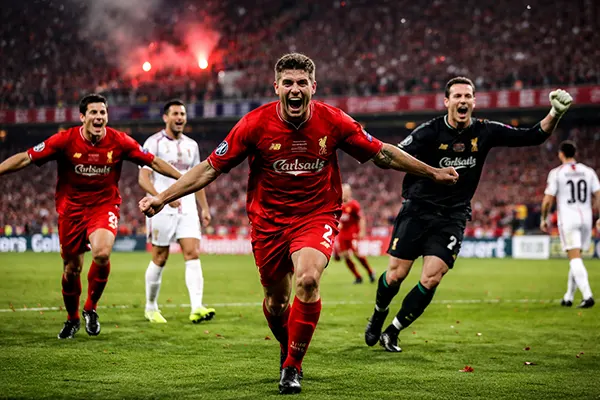
The 2005 UEFA Champions League final in Istanbul is often retold as a miracle, but it’s more useful to treat it as a case study in how teams react to stress, how momentum is manufactured, and how a few minutes can change what both sides believe is possible. AC Milan led 3–0 at half-time through Paolo Maldini’s first-minute finish and a Hernán Crespo brace late in the half, yet Liverpool levelled in a six-minute burst after the break before winning 3–2 on penalties. The sequence matters: the comeback wasn’t a single emotional wave, it was a chain of tactical tweaks, leadership cues, and small “yes, this can happen” moments that forced Milan into unfamiliar decisions.
Why 0–3 at half-time was not a death sentence
The scoreline was brutal, but it didn’t mean Liverpool had been outplayed in every lever of the game. Finals are emotional amplifiers: one early goal can distort risk management for 45 minutes, and that’s exactly what Maldini’s opener did. Milan could sit in a structure that protected the centre, keep Andrea Pirlo as a metronome, and wait for mistakes; Liverpool had to chase, which raises variance and makes you look worse when the opponent punishes transitions.
Rafael Benítez’s half-time response was practical rather than theatrical. He introduced Dietmar Hamann and reshaped the midfield/defensive balance, prioritising control of the second ball and quicker circulation to the wide areas. When a team is 0–3 down, “belief” only sticks if the next actions are simpler: win duels, push the line up five metres, get crosses in early, and give the opponent new pictures to solve.
Psychology also sits in tempo. At 0–3, the temptation is to play frantic football and hope for chaos. Liverpool’s better route was controlled urgency: make the match faster for Milan without making it messy for themselves. That difference is subtle, but it’s the bridge between “we’re desperate” and “we’re still a functioning side.”
The first goal as a psychological permission slip
The captain’s goal was not just a finish; it was a public signal that the match had a second phase. Steven Gerrard’s header in the 54th minute gave Liverpool a concrete target (one goal, then another), and it forced Milan to re-evaluate what “safe” looked like. A three-goal cushion invites composure; a two-goal cushion after conceding invites doubt, because the opponent has evidence that they can hurt you.
Notice how quickly the second goal followed. Vladimír Šmicer’s long-range strike in the 56th minute did something that tactics alone rarely achieve: it made Milan’s next decision emotionally loaded. Do you slow the match down and risk inviting pressure? Do you press higher and risk being played through? Under sudden threat, teams often split internally—some players want control, others want aggression—and that split is fertile ground for mistakes.
The equaliser arrived via a penalty at 60 minutes, but the critical point is the compression of events: 54, 56, 60. That time clustering is why the comeback felt unstoppable. When goals arrive in quick succession, the trailing side’s confidence rises faster than the leading side can stabilise, and the match becomes less about the original plan and more about who can reset their nervous system first.
How a short chain of events changes the favourite’s behaviour
When a team that expects to win starts to feel the game slipping, decision-making becomes conservative in the wrong places and reckless in the wrong places. After 3–3, Milan still had quality and chances, but the emotional texture had changed: possession is no longer a comfort if you fear the turnover, and passing becomes “safe” rather than “penetrative.” That’s how favourites start playing not to lose, even when they still have the tools to win.
Liverpool’s behaviour also shifted, but in the opposite direction. The comeback didn’t simply lift energy; it simplified roles. Full-backs and wide players became delivery points, central midfielders became second-ball hunters, and forward runs became more direct. In high-pressure matches, clarity beats creativity: if everyone knows the next three actions, hesitation disappears, and hesitation is what opponents read as weakness.
There’s also the crowd factor, but not in a mystical way. Noise changes communication costs. When a stadium is loud, teams rely more on habit and less on instruction, and that can punish a side whose emotional state is wobbling. Liverpool’s habits after scoring—pressing the next pass, playing forward earlier, taking shots without overthinking—were aligned with the moment; Milan’s habits became disrupted by the need to “manage” the situation.
Turning points are often defensive, not attacking
Many people remember only the three Liverpool goals, but the match hinged on interventions that prevented Milan from regaining certainty. A clear example is the moment around the 70th minute when Andriy Shevchenko came close and Liverpool survived the danger. In these phases, the trailing side’s mindset can collapse if they concede immediately after equalising; surviving the first big scare is a turning point because it confirms that the comeback is not fragile.
Defensive turning points are team-wide: who tracks runners when legs are heavy, who blocks the shooting lane without diving in, who wins the rebound when the body wants to switch off for half a second. These details don’t go viral, but they are the hidden hinge of “momentum.” If you live through the opponent’s best punch, your belief becomes sturdier than any speech.
By extra time, the psychological battle was about fatigue management and error avoidance. Players make more technical mistakes when mentally tired, not only physically tired, and finals are mentally exhausting. Liverpool’s task was to keep their structure and avoid a cheap concession; Milan’s task was to reassert control without chasing the perfect chance. That tension set the stage for penalties.
Why penalties are a separate match within the match
A penalty shootout looks like a simple skills contest, yet it’s closer to a stress test with a football attached. The physical technique matters, but the dominant variable is arousal control: heart rate, breathing, and attention. By the time a final reaches penalties, players are managing cramps, minor knocks, and cognitive overload from 120 minutes of scanning, tracking, and reacting.
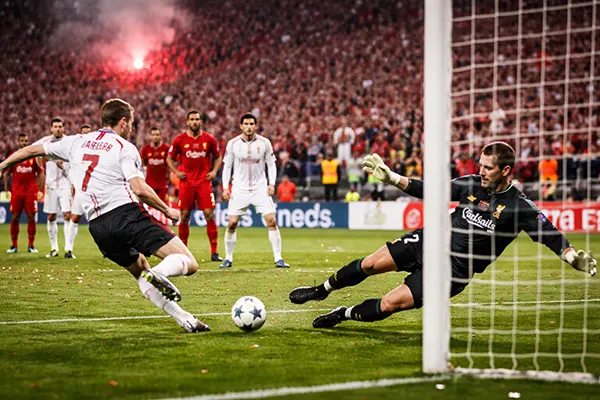
The 2005 shootout illustrates how quickly narrative can flip again. Milan went first, and Serginho missed high, which immediately hands the other side a psychological edge because the “must score” pressure arrives early. Liverpool converted through Dietmar Hamann and Djibril Cissé, while Jerzy Dudek saved Andrea Pirlo’s effort; suddenly Milan were playing catch-up in a format where every miss feels terminal.
Even when Liverpool missed—John Arne Riise’s penalty was saved—the shootout didn’t revert to neutral. That’s the key: shootouts have mini-swings inside them. Players don’t experience the score as “level”; they experience it as “what happens if I fail.” The final swing arrived when Dudek saved Andriy Shevchenko’s penalty to seal a 3–2 win, after having also produced a crucial double save from Shevchenko in extra time.
The mechanics of pressure: goalkeeper behaviour, order, and coaching choices
Goalkeepers influence penalties before the kick is taken. Dudek’s movement and distraction techniques are a classic example of using the rules’ grey areas to raise the kicker’s cognitive load. If the taker’s attention shifts from “my spot, my routine” to “what is the keeper doing,” execution quality drops, especially late in a shootout when fatigue and tension are already high.
Order matters too. Coaches often place their most reliable takers early to build a base score, but there is a trade-off: if you save your best kicker for the fifth, they might never take one. In Istanbul, Liverpool’s early conversions created scoreboard pressure, while Milan’s early miss forced their later takers into a survival mindset. That is why the first penalty can be more influential than the last.
Finally, penalties reward teams that rehearse routines under stress, not only technique on a training ground. The lesson for modern football (and it still holds in 2026) is straightforward: build a repeatable process—breathing, visualisation, a fixed start point, and one technical cue—and train it when players are tired. A shootout is not a lottery; it’s a performance environment with predictable psychological triggers.