


Solheim Cup 2026: How Europe Beat the USA to Reclaim Women’s Golf’s Biggest Team Trophy
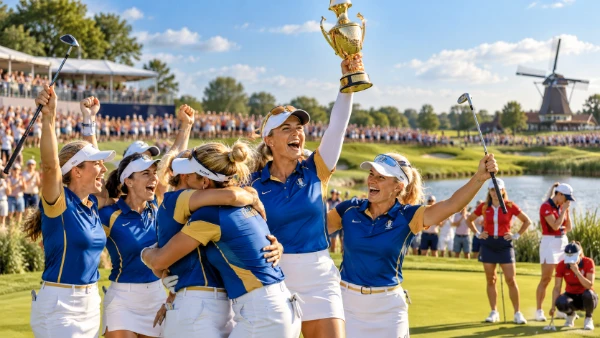
Europe reclaimed the Solheim Cup on 13 September 2026, defeating the United States 15–13 after three days of fiercely contested women’s team golf at Bernardus Golf in Cromvoirt, the Netherlands. Under captain Anna Nordqvist, the European side recovered from a difficult previous edition and delivered an outstanding performance in the final singles session. Carlota Ciganda secured the decisive point, while Linn Grant completed a perfect tournament with four victories. The result ended American hopes of retaining the trophy they had won in 2024 and gave Europe its first Solheim Cup victory on Dutch soil. More importantly, the competition demonstrated how teamwork, experienced leadership and emerging talent could overcome a formidable American squad.
Solheim Cup 2026 Results: Europe’s Road to a 15–13 Victory
The 20th edition of the Solheim Cup took place from 11 to 13 September 2026 at Bernardus Golf, near the Dutch city of ‘s-Hertogenbosch. It was the first time the Netherlands had hosted the competition, adding another chapter to an event that began in 1990. Europe entered the tournament determined to recover the trophy following a 15½–12½ defeat at Robert Trent Jones Golf Club in Virginia in 2024. The Americans arrived as defending champions, with Angela Stanford serving as captain and several established LPGA stars in their squad. Although home support gave Europe an encouraging atmosphere, the outcome remained uncertain because both teams possessed considerable individual talent.
The opening day established how closely matched the two sides were. Friday’s morning foursomes finished 2–2, and the afternoon four-ball matches produced the same score, leaving the overall contest level at 4–4. In foursomes, two players share one ball and take alternate shots, making communication and mutual trust particularly important. Four-ball matches allow each golfer to play their own ball, with the better score from each partnership counting on every hole. These contrasting formats tested the players’ ability to cooperate while maintaining their individual strengths. Neither captain could establish a meaningful advantage, and the opening exchanges suggested that small moments would eventually decide the trophy.
Saturday brought the first major change in momentum. Europe won the morning foursomes session 3–1, establishing a 7–5 overall advantage and placing pressure on the defending champions. However, the Americans responded by taking three of the four afternoon four-ball matches. Alison Lee, Lauren Coughlin, Jennifer Kupcho and other members of Stanford’s squad contributed to an important recovery. Kupcho and Lindy Duncan delivered a particularly dramatic victory against Carlota Ciganda and Céline Boutier, overturning the position late in their match. By Saturday evening, the score stood at 8–8. With all 12 singles matches still to come, both teams had an equal opportunity to determine the championship.
Sunday Singles: The Matches That Secured Europe’s Comeback
Sunday’s singles session became the defining period of the 2026 Solheim Cup. Europe needed 14½ points to reclaim the trophy outright, while the United States required 14 points to retain it. Every player competed individually, with one point awarded for a match victory and half a point to each side for a tie. Nordqvist’s team delivered seven points from the available 12, winning the singles session 7–5. The European victories were not concentrated around one established star. Contributions came from experienced competitors and younger players alike, preventing the Americans from controlling the scoreboard despite several impressive individual performances.
Charley Hull defeated Megan Khang 3&2, while Linn Grant produced a commanding 4&3 victory over Angel Yin. Nanna Koerstz Madsen added another European point by beating Allisen Corpuz 2&1. Young French golfer Nastasia Nadaud overcame Andrea Lee 3&2, and Spain’s Julia López Ramírez defeated Yealimi Noh by the same margin. Lottie Woad also contributed with a 2&1 victory against Auston Kim. These results showed the depth of Europe’s squad. Rather than depending entirely on its most recognisable names, the team found winning performances throughout the singles order, an essential advantage in a competition where every match carries equal value.
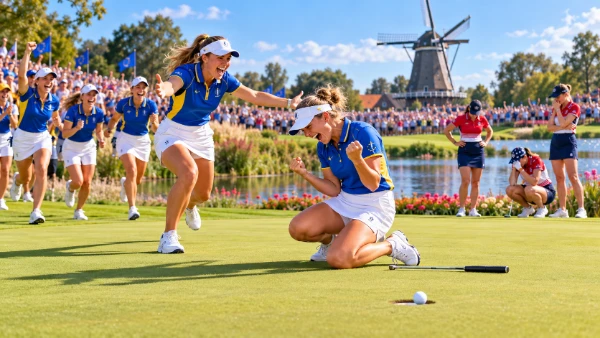
The decisive moment belonged to Carlota Ciganda, who defeated Jennifer Kupcho 4&2 to secure the point that guaranteed Europe’s victory. Her success carried particular significance because she had also delivered the crucial point when Europe retained the trophy in Spain in 2023. Ciganda became only the second player in Solheim Cup history to secure the decisive point twice, following Scotland’s Catriona Matthew. The Americans still produced notable results, including Nelly Korda’s 4&2 victory over Mimi Rhodes and Alison Lee’s remarkable comeback against Esther Henseleit. Nevertheless, Europe’s wider contribution across the singles matches proved sufficient. When the final score settled at 15–13, Nordqvist’s players could celebrate regaining the trophy in front of their home supporters.
Europe’s Solheim Cup Heroes: Leadership, Experience and Emerging Talent
Anna Nordqvist’s captaincy was central to Europe’s successful campaign. The Swedish golfer brought extensive Solheim Cup experience to the role, having represented Europe repeatedly during her playing career. Her understanding of the event’s demands helped her manage a squad containing established international competitors alongside players making their first appearance. Team selection in the Solheim Cup involves more than choosing golfers according to individual results. Captains must consider personalities, partnerships, confidence and the ability to perform under pressure. Nordqvist’s decisions were particularly important during the opening two days, when players competed in pairs and had to adapt to different partners and formats.
Linn Grant emerged as Europe’s most successful individual performer, winning all four matches she contested. Her perfect 4–0–0 record represented an extraordinary reversal from the 2024 competition, when she lost all four of her matches. Grant became the first player in Solheim Cup history to earn at least four points immediately after recording none in her previous appearance. Her performance was especially valuable because she contributed in both partnership golf and singles. Alongside fellow Swede Maja Stark, she secured a 2&1 victory against Megan Khang and Lauren Coughlin in Saturday’s afternoon four-ball session. Grant then completed her tournament with an emphatic singles success over Angel Yin, providing another example of her growing importance to European women’s golf.
Carlota Ciganda offered a different form of leadership through her experience and ability to deliver under pressure. Although the Spaniard had endured disappointment in some earlier sessions, she responded when Europe most needed her contribution. Her victory against Kupcho demonstrated the importance of resilience in match play, where a golfer’s previous result has no direct bearing on the next contest. Charley Hull, meanwhile, remained a prominent figure in the European line-up despite facing difficult American opposition during the pairs sessions. Her Sunday victory against Megan Khang provided a valuable point and ensured that one of Europe’s best-known players finished the event positively. Together, these performances gave the squad a combination of competitive stability and match-winning quality.
How Europe’s Young Players Made a Difference
One of the most encouraging aspects of Europe’s victory was the contribution made by its younger golfers. French newcomer Nastasia Nadaud finished with three victories and one defeat, an excellent return for a player experiencing the Solheim Cup for the first time. She also formed a successful partnership with English rookie Mimi Rhodes. The pair became the first all-rookie partnership in the competition’s history to win two matches together, recording victories in different formats across the opening two days. Their success suggested that Europe’s next generation could adapt quickly to international team competition. For Nordqvist, the results also justified placing confidence in players without extensive experience of the event.
Lottie Woad and Julia López Ramírez strengthened that impression during Sunday’s singles matches. Woad defeated Auston Kim 2&1, while López Ramírez secured a convincing 3&2 win against Yealimi Noh. Both victories mattered because the Americans had demonstrated considerable strength in the earlier sessions. Young competitors can find the Solheim Cup particularly demanding: the crowds are vocal, national and continental expectations are high, and every hole can influence the overall contest. Unlike a conventional stroke-play tournament, a poor opening does not necessarily ruin an entire round. Players must remain focused on winning individual holes, adjusting their approach whenever an opponent gains an advantage.
The American team also produced performances deserving recognition. Alison Lee completed the tournament with four wins from four matches, becoming the first player to achieve a perfect four-win record for a losing Solheim Cup side. Her singles victory over Esther Henseleit was particularly extraordinary because she recovered from four holes down, completing the biggest comeback recorded in the competition’s history. Jennifer Kupcho provided important contributions during the partnership sessions, while Nelly Korda secured a convincing singles victory against Mimi Rhodes. These achievements underline why the final score should not be interpreted as evidence of American weakness. The difference was that Europe obtained more points across the complete team, even though several American golfers delivered outstanding individual performances.
Why the 2026 Solheim Cup Victory Matters for Women’s Golf
Europe’s victory changed the recent direction of one of women’s golf’s most important rivalries. The United States had recovered the trophy in 2024 after Europe enjoyed a successful period that included victories in 2019 and 2021 and a dramatic retention in 2023. By winning in the Netherlands, Europe prevented the Americans from establishing a longer sequence of victories. Following the 2026 contest, the overall historical record stood at 11 American victories, eight European victories and one tie. Europe also improved its record when hosting the competition to six wins, three defeats and one tie. Although the United States continued to lead the all-time series, the result reinforced Europe’s ability to compete successfully against a country with an exceptionally deep professional golf structure.
The Solheim Cup occupies a distinctive position in women’s sport because its importance cannot be measured through individual rankings or prize money. Named after Karsten and Louise Solheim, whose support helped establish the tournament, the event brings together leading golfers from Europe and the United States every two years. Its format encourages players who normally compete against one another to cooperate towards a common objective. The 2026 edition offered another example of this appeal. European supporters followed every change on the scoreboard, while American fans celebrated individual achievements and late recoveries. The atmosphere gave spectators an opportunity to experience professional golf as a direct contest between two teams rather than a conventional individual leaderboard.
Hosting the event at Bernardus Golf also represented an important moment for the Netherlands. The country had previously welcomed major international golf competitions, but staging the Solheim Cup brought a particularly prominent women’s sporting event to Dutch audiences. Bernardus, located in Cromvoirt in the province of North Brabant, provided the setting for three days of international competition. Its fairways, greens and strategic challenges demanded accurate driving, careful approach shots and confident putting. However, the venue’s greatest contribution was providing a stage on which spectators could follow the tension of team golf at close range. The successful staging of the event demonstrated how the Solheim Cup can attract attention beyond countries traditionally associated with hosting the competition.
What Europe’s Triumph Means for the 2028 Solheim Cup
The next Solheim Cup is scheduled for 8–10 September 2028 at Valhalla Golf Club in Louisville, Kentucky. The competition will return to the United States, placing Europe in the position of defending champion. Under Solheim Cup rules, the team holding the trophy retains it if the following contest finishes level at 14–14. Consequently, Europe will need at least 14 points in 2028 to retain the trophy, whereas the Americans must reach 14½ points to regain it. Although those requirements appear straightforward, the 2026 contest demonstrated how difficult it can be to secure the necessary points. The match was tied entering the final day, and only Europe’s superior singles performance ultimately settled the result.
The 2028 competition will present a fresh challenge for both sides. Europe must determine how best to build upon the progress shown by Grant, Nadaud, Woad and López Ramírez while retaining the experience required to handle difficult away conditions. The United States will seek to convert strong individual results into a more successful overall team performance. Players such as Alison Lee, Nelly Korda and Jennifer Kupcho have already demonstrated their ability to succeed in the demanding Solheim Cup environment. However, future team selections and partnerships will depend on form, qualification and captaincy decisions closer to the tournament. The two-year interval also allows emerging golfers from both continents to strengthen their claims for inclusion.
The 2026 Solheim Cup will be remembered for Europe’s determined final-day performance, Linn Grant’s perfect record and Carlota Ciganda’s second decisive singles victory. Its most important lesson was that successful team golf depends on contributions throughout the squad. Europe did not dominate every session, nor did its leading players win every match. Instead, the team responded to American pressure, trusted its younger members and produced its strongest collective performance when the trophy was at stake. The 15–13 result restored European pride after the disappointment of 2024 and provided another memorable chapter in the competition’s history. With the next meeting scheduled for Kentucky, the rivalry continues with Europe once again holding women’s golf’s most prestigious transatlantic team trophy.